Skip to content

Gender & Agency / A design audit by Riya Kamat

Who Is a Gym Designed For?

The barriers to strength training begin long before a woman reaches the weights room.

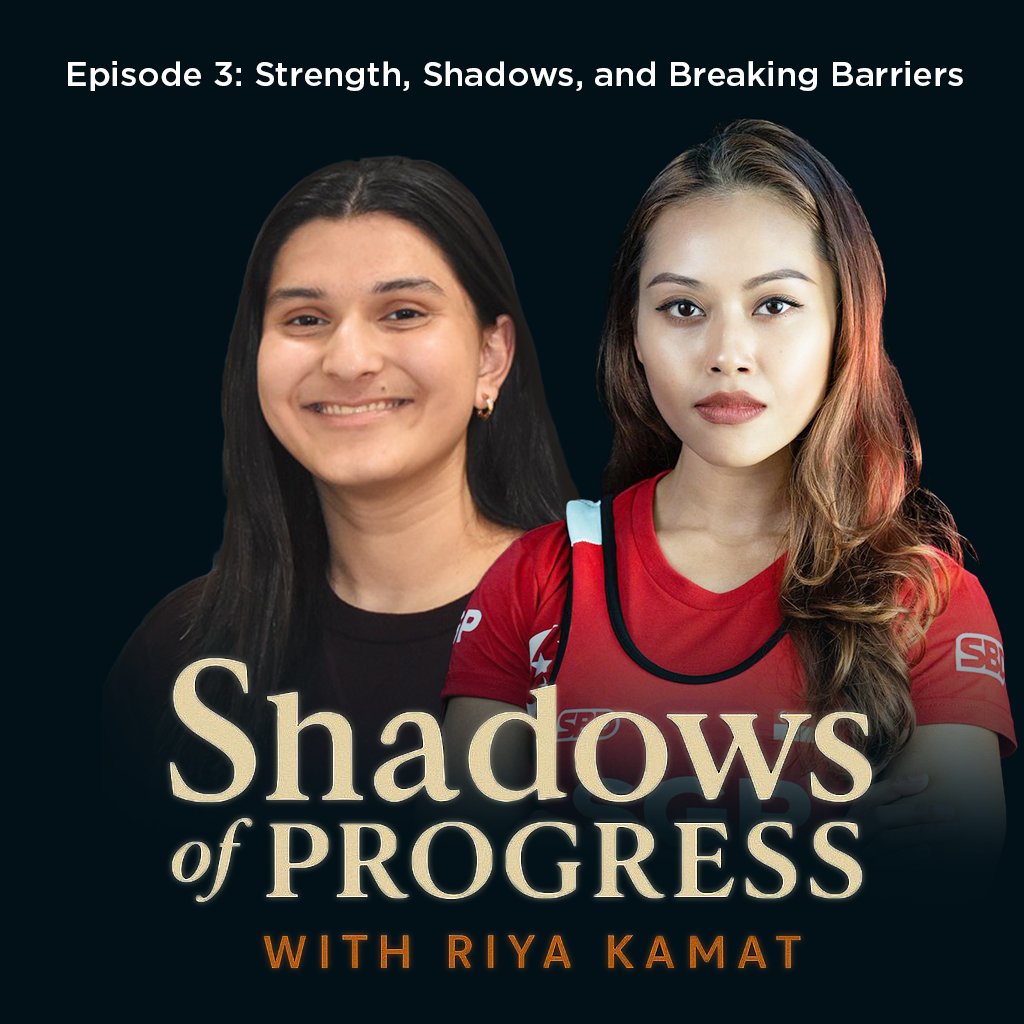
With Farhanna FaridSingapore's Record-Breaking Powerlifter
Farhanna Farid — Shadows of Progress, episode 3

The conversation, at a glance

A system. A blind spot. A different starting point.

01

The system

The cultural and physical pathway into strength training, from childhood exposure to sustained participation.

02

Who it overlooks

Girls and women facing family expectations, unfamiliar equipment, and the social cost of staying.

03

Riya’s proposed direction

Design a beginner pathway with the people using it, making the gym’s unwritten rules visible.

Sometimes resilience just looks like showing up and going through the motion.

Farhanna Farid, in conversation

The design audit / By Riya Kamat

Looking beneath the surface.

7 minute read · Complete source text

Download auditDOCX · 19 KB
Jump to an audit section

Who Is a Gym Designed For?

Shadows of Progress: Episode 3

Guest: Farhanna Farid, Singapore powerlifter and deadlift world record holder

01

The System

During the interview, Farhanna Farid said something that is worth exploring further. Strength training is, in her words, “sort of like a rite of passage for young males.” She said it as a description, but the phrase is doing more analytical work than its tone gave away. It says there is a passage. It also says the passage has a sex, and that the sex is not hers, and not mine.

Farhanna is Singapore’s record-breaking powerlifter. She has spent her career walking a route into strength sport that was not built for her. The system this episode is exploring is the route itself: the years of cultural induction that happen before a teenager walks into a weight room. The gym is not the system. The gym is the place where the passage either delivers a person or never does. By the time anyone reaches the door, the question of whether they belonged there has mostly already been answered.

02

The Intended User

The default user of strength training environments was a boy who encountered weights during adolescence as a normal developmental activity. His body changes were framed as growth. His family treated muscle gain as a sign of maturing into himself. His peers did the same training. He absorbed gym etiquette by osmosis from older boys. The infrastucture that followed, including gyms, coaching cultures, equipment, federation structures, and marketing, assumed this user already existed and built itself around him.

A girl arriving at the same gym at sixteen, or twenty-five, or thirty-five is not entering a neutral space. She is walking into an environment built for someone whose biography is not hers. The cardio machines feel easier because they look like the home cardio she has seen women do. The weight racks are harder because nothing in her cultural script has told her she belongs there. This is not a statement about her natural inclination; it is a statement about how the space has been designed, coded, and made legible for someone else.

03

Hidden Exclusions

The exclusions this design produces happen at different points in a girl’s life. One does its work before she would ever have walked into a gym. The other does its work after she has already started training, when staying becomes its own cost.

The first is the girl whose family does not recognize strength training as developmentally appropriate. Farhanna describes her own mother worrying about whether heavy lifting would affect her reproductive health. That worry is not idiosyncratic. It belongs to an entire framework in which women’s bodies are evaluated for fertility and aesthetic outcomes rather than for capability. A teenage girl whose family applies this framework cannot easily develop strength training even when her local gym is technically open. The exclusion has done its work years before she would have walked in.

The second is the woman who reaches the gym but cannot afford the social cost of staying. Farhanna describes the body image transition honestly: clothes that no longer fit, photographs that show a body she had to get used to. She had a partner who celebrated her strength rather than her shape. A woman without that support faces a colder calculation: stay strong and feel out of step with peer or family aesthetic norms, or scale back to fit them. The exclusion happens not at the moment of entry but in the months that follow, when the gym is still open but the rest of her life starts to compete with it.

Farhanna also names a third layer. She mentions that federation-level safeguards for female athletes could be strengthened. A federation that is technically open but where female athletes do not feel safe to express themselves is also a structural barrier. This is the layer of exclusion you only see from the inside of the sport, which is why it is so rarely named from the outside.

04

Embedded Values

The design choice to treat strength training as a developmental trajectory beginning in adolescence reveals what this system actually optimizes for: the male growth pathway from boyhood into strength, and the infrastructure that supports anyone already on that pathway. Gym memberships, lifter counts, competition participation, equipment sales, every metric the system uses tracks people moving along this trajectory.

A thirty-year-old woman just starting out is in the same gym, using the same equipment, surrounded by the same culture, but moving through a different developmental arc. She has to acquire fluency the system assumed she already had. The infrastructure is not hostile. It is just not designed for her arrival pattern.

The deeper value embedded in this system is that childhood exposure is treated as a private matter. Families decide. Schools decide, or do not. Peer groups decide. The strength infrastructure begins its work only after that decision has been made elsewhere by someone else. By the time a girl reaches the gym door, the most important determinant of whether she will stay has already been settled in a place the gym has no reach into. The system measures arrivals. It does not measure the path that produced them.

05

Ethical Redesign

The three redesigns that follow act at three different stages of the path. One acts well before someone reaches a gym, in primary school. The other acts at the gym itself, in how its codes are taught and to whom. The last one acts beyond the gym, inside the federations that determine whether a woman who has arrived can stay safely. None of them assume the work can be done at a single point.

The first is structured strength education in primary school physical education. Farhanna names this directly in the conversation. Age-appropriate body-weight strength work, taught in mixed-gender classes as a basic motor literacy, alongside running and ball sports. Schools will object that they lack equipment and qualified teachers. Body-weight strength training though requires no equipment. The aim is not to produce powerlifters. It is to ensure that by the time a girl is fourteen, the weight rack is not unfamiliar terrain.

Also, gym environments should not require cultural fluency to navigate. The current arrangement asks newcomers to absorb unwritten codes: what chalk is for, how to ask to work in, when to wait, how long a piece of equipment is socially yours, what eye contact means and does not mean. These are not posted. They are absorbed slowly by people whose peers were already inside those environments. The solution is straightforward: etiquette signage, clearly marked beginner zones without the implication of segregation, and a hosted orientation rather than a self-directed one. Some will perceive this as patronizing. However, the current arrangement is not a gym community. It is a gym community for people fluent in its codes.

Finally, federation-level safeguards should be built around female athlete safety. Farhanna raised this explicitly. This entails specific policies on coach-athlete conduct, reporting channels that do not route through the federation hierarchy, and regular independent safety audits. The federation might say that this introduces friction into a functioning system. Nevertheless, a federation can be functioning for the athletes it serves and structurally unsafe for the athletes it does not. Naming the gap and auditing it is how it learns which it is for whom.

06

Reflection

Before this interview, I thought I understood what was happening in strength sport. The numbers are clear. Fewer women than men compete. Fewer women than men train. The explanations available, such as biology, preference, and time, were each plausible enough on their own that the gap could be filed away as something that did not require further thinking.

Farhanna's “rite of passage” line did something to those explanations. It said the imbalance is not a preference difference. It is the residue of a passage that was built for someone else, and the imbalance persists because the passage persists. Once I heard it that way, I could not hear it any other way. The numbers in elite competition stopped looking like the result of women’s choices. They started looking like the result of the choices made by the institutions, families, and cultures that determine which children are inducted into strength.

What I want to stay with is how much explanatory work the word “preference” was doing in the version of this question I had carried before the conversation.

The system, made visible

Follow the connections.

Select an element to see how it connects to the rest of the system, and who falls outside its assumptions.

The path into strength training.

Exclusion acts at different stages, including before someone has considered entering a gym.

01 / Childhood

02 / Adolescence

03 / First entry

04 / Staying

Where the pathway breaks

Explore the system

Where would you begin?

Select any element to highlight its connections and jump to the part of the audit it comes from.

Interpretive map by Riya Kamat. Connections describe the source analysis; they are not a quantitative model.
Download mapPDF · 121 KB
Read the complete map as text

I N P U T S

W HO S E I NT E R E S T S I T S E R V E S

O U T P U T S

Federations Member counts, sport status Sport industry Equipment, coaching, gyms Family attitudes Developmental framing, body norms School & PE Exposure to weights, motor literacy Peer culture Normalization, body framing The path into strength training A sequence of cultural inductions. Each stage has its own exclusion mechanism.

1 Childhood exposure PE, family attitudes, body norms 2 Adolescent socialization Peer groups, body framing, culture 3 First gym entry Equipment fluency, etiquette 4 Sustained participation Body image, social cost, identity Capability Strength, technique Identity Athlete self-conception Competition Federation participation Excluded zone Each group is excluded by a mechanism operating at a different stage of the pipeline above.

Girls whose families do not recognize strength training as developmentally appropriate • Body framed for fertility and aesthetic outcomes, not capability.

• Family applies this framework years before the gym is a question.

• Exclusion has done its work before she would have walked in.

Operates at Stage 1: childhood exposure Women who reach the gym but cannot afford the social cost of staying • Body changes feel out of step with peer or family aesthetic norms.

• Without supportive partner or community, calculation gets colder.

• Exclusion happens in the months after entry, not at the door.

Operates at Stage 4: sustained participation

E P I S O D E 3

Who Is a Gym Designed For?

From inquiry to possibility

Take the thinking further.

Workshops, proposals, and practical resources developed alongside this conversation. Read them here or download the original files.

Companion resource / DOCX

Designing the Beginner Path Workshop

Download originalDOCX · 26 KB
Read the full resource

Designing the Beginner Path Workshop

This workshop is a sixty-minute participatory redesign session with five to eight women who are new to strength training. It is not a focus group. The participants are not being studied; they are being treated as the people who know what walking into a weight room as a beginner woman is actually like, which is knowledge no gym designer can produce from outside that experience.

The session has one job: to generate design insight that a person redesigning a gym’s beginner path could actually use. Sixty minutes is not enough to produce a redesign. It is enough to produce direction: what patterns recur, what priorities the participants share, what blind spots the current design has.

Who this workshop is for

Women who have been training with weights for less than twelve months. Open to all body types, fitness backgrounds, and reasons for training. Conducted in a language the participants share. No prior workshop experience required. The cohort should be mixed enough that no single woman is the most experienced or the least experienced person in the room by a large margin: extreme outliers in either direction will shape the conversation around themselves.

Who this workshop is not for

Women who have been training for more than a year. Their experience is valuable, but it is a different workshop. Their fluency will silence beginners who have not yet developed the language for what they are experiencing. Personal trainers, coaches, and gym staff also do not belong in this session. The point is to surface what beginners notice.

Group size and setup

Five to eight participants. Below five and the conversation begins to lose depth; above eight and the format can no longer give each woman enough space to speak..

A private room outside the gym itself. Not in a gym lobby, not in a studio, not in a space that smells of chalk. The gym’s atmosphere is part of what is being redesigned, and conducting the session inside it will skew what participants feel free to criticize. A community space, a meeting room in a library, a co-working studio. A neutral ground that is not associated with strength training.

Materials

For each participant: a printed worksheet booklet, three coloured sticky-note pads (yellow, blue, pink, used for different exercise types, explained below), pens. For the group: two flipchart sheets, a roll of masking tape, and a printed photograph or simple line drawing of a typical commercial gym layout used in the second exercise. Snacks and water.

Facilitator profile

Someone who has trained women lifters but is not currently coaching any participant in the room. Familiarity with gym culture is necessary; current authority over any participant is disqualifying. The facilitator’s job in this session is to extract design insight, not to teach or correct. A coach who instinctively wants to fix a participant’s understanding of a piece of equipment will compromise what the session is for.

The sixty minutes

Opening (5 minutes): Framing the room. The facilitator names the workshop’s job in one sentence: we are here to figure out what would make this experience easier for the next woman who walks in. Each participant introduces herself with first name, how long she has been training, and one word for what walking into a gym felt like the first time. The facilitator writes the words on a flipchart and refers back to them at the end.

Exercise 1: Moment-mapping (15 minutes): Solo, then group. Each participant gets five yellow sticky notes. The prompt: write down five moments from your first three months of training when something was confusing, uncomfortable, or made you feel like you did not belong. One moment per note. No explanation needed, just the moment. The notes are then placed on a flipchart organized by the facilitator into rough categories as they are added: equipment confusion, social uncertainty, body self-consciousness, etiquette unclarity, other. The participants do this together so the categories emerge from the notes, not from a facilitator’s pre-built taxonomy.

Possible prompts to read aloud, slowly, to help participants access their experiences:

  • the moment you first stood in front of a piece of equipment and could not work out how it functioned
  • a time someone watched you in a way that made you uncertain whether you were doing something wrong
  • a moment you waited for something and were not sure if you were allowed to be waiting
  • a time you walked into the gym and immediately wanted to leave

Exercise 2: Walk-through (15 minutes): Pairs. Each pair receives a simple line drawing of a typical commercial gym layout. Using blue sticky notes, each pair marks the locations on the layout where the moments they wrote down took place. The point is not the layout itself but the geography of friction: patterns emerge when ten or fifteen sticky notes cluster around the same physical space (the squat rack area, the dumbbell rack near the mirrors, the equipment storage corner). The facilitator does not interpret the clusters out loud during the exercise. The pairs share what they notice when they reconvene.

Reconvene and prioritization (15 minutes): Full group. Each participant gets three pink sticky notes labelled “if you fixed one thing, fix this.” Each woman places her three notes on the moment-map flipchart from Exercise 1, voting for the three categories or specific moments she thinks would matter most to fix. No discussion during voting. Once the votes are placed, the facilitator names what the room has prioritized and asks two open questions: what is on this map that surprised you, and what is missing from this map that you wish were on it.

Closing (10 minutes): Synthesis and resources. The facilitator summarizes what the room has produced: the categories that emerged in Exercise 1, the geographies that emerged in Exercise 2, the priorities that emerged in the voting. Each participant is invited to add one sentence to the closing flipchart, optional, about anything she did not get to say. The session ends. The facilitator does not promise the participants that anything will be changed because of what they have said:overpromising is the fastest way to lose the room’s trust in the next session like this one.

Facilitation notes: the harder moments

If a participant blames herself for a moment that is clearly a design failure. This will happen. A participant will say “I should have just asked someone.” The facilitator’s response is not to correct her, but to write the moment on the flipchart in the participant’s own words and let the group’s later mapping show whether the pattern is hers alone or shared. Telling a beginner she is wrong about her own experience might silence her for the rest of the session.

If a participant who has been training longer than the others starts answering on behalf of beginners. Name the role gently: “I want to make sure the women who started most recently get the floor first, because their first months are the freshest.” The longer-trained participant is still useful. She can speak in the later exercises about what she wishes had been there for her.

If the room defaults to gym-staff blame. Real, but a distraction. The workshop is about redesigning the path, not faulting the staff. Acknowledge specific complaints in the moment (“that sounds frustrating, and I want to come back to it”) and redirect: “if a staff member were not part of the picture, what would the space itself need to do differently?”

If a participant gets emotional describing a moment. Pause, offer water, do not push her to elaborate. Offer her the option to step out briefly with another participant. The exercise continues with the rest of the group. Do not make her absence the subject of discussion.

If the facilitator is tempted to teach. Almost all gym-experienced facilitators will be. Resist. A participant who says she does not understand what chalk is for has just identified a design failure (no signage, no orientation). The facilitator’s job is to write that down, not to explain chalk.

What this workshop typically surfaces

A workshop of this kind is structured around a small number of patterns that tend to surface. A redesigner reading this section should expect to see most of these in the output of a single session, with one or two specific to the particular gym the participants train in:

  • Equipment legibility issues cluster around free-weight stations and cable machines with multiple attachment options. The complaint is rarely “I cannot use it.” It is “I cannot tell whether I am using it correctly, and I do not know how to find out without looking foolish.”
  • Social-uncertainty moments cluster around shared equipment (squat racks, benches), mirrors, and high-traffic walkways. The complaint is about being watched, but most of what creates the feeling is physical: where the mirrors face, where walkways pass, where shared equipment is placed relative to lines of view.
  • Etiquette unclarity moments cluster around waiting (what does “working in” mean, how do I ask, how long is too long to wait), chalk and equipment cleanup (what is expected, what is judged), and music or headphones (am I rude if I have them in).
  • Body self-consciousness is consistently named as a layer underneath every other category. It is not a separate friction; it intensifies all the others. A beginner who is also self-conscious about her body will find equipment confusion harder to admit, social uncertainty harder to navigate, etiquette gaps harder to ask about.
  • The most common request, when participants vote on what to fix first, tends to be some version of “a way to know what I am supposed to do without having to ask.” Posted signage, guided orientations, an opt-in beginner zone.

What the workshop produces

By the end of sixty minutes the design team should walk away with three concrete artifacts:

1. The moment-map flipchart. A clustered, categorized record of the kinds of friction beginners experience. This is the qualitative dataset that informs which features of the redesign matter and which do not.

2. The geography overlay. Sticky-note clusters on the gym layout drawing, showing where in physical space the friction concentrates. This is the spatial dataset that informs equipment placement, sight lines, and signage location.

3. The priority vote. The women’s own ranking of what would matter most to fix first. This is the prioritization signal that prevents the design team from optimizing for the friction the designers find most interesting rather than the friction the users find most consequential.

What this workshop is intentionally not designed to do

It does not produce a redesigned gym. Sixty minutes with seven women cannot. It produces the inputs a redesigner needs to start the work honestly.

It does not validate the redesigner’s existing ideas. If the session is run with the intent of confirming a design that has already been chosen, it will become a focus group presented as a workshop, and the participants will know. They will give answers that flatter the facilitator and the room will produce nothing useful.

It does not promise the participants that what they have said will result in any change. Overpromising compromises trust in the next workshop and in any workshop run by the same organization afterward. The honest thing to say at the end is: this is now in front of the people who are deciding what to do next; we will tell you what happens.

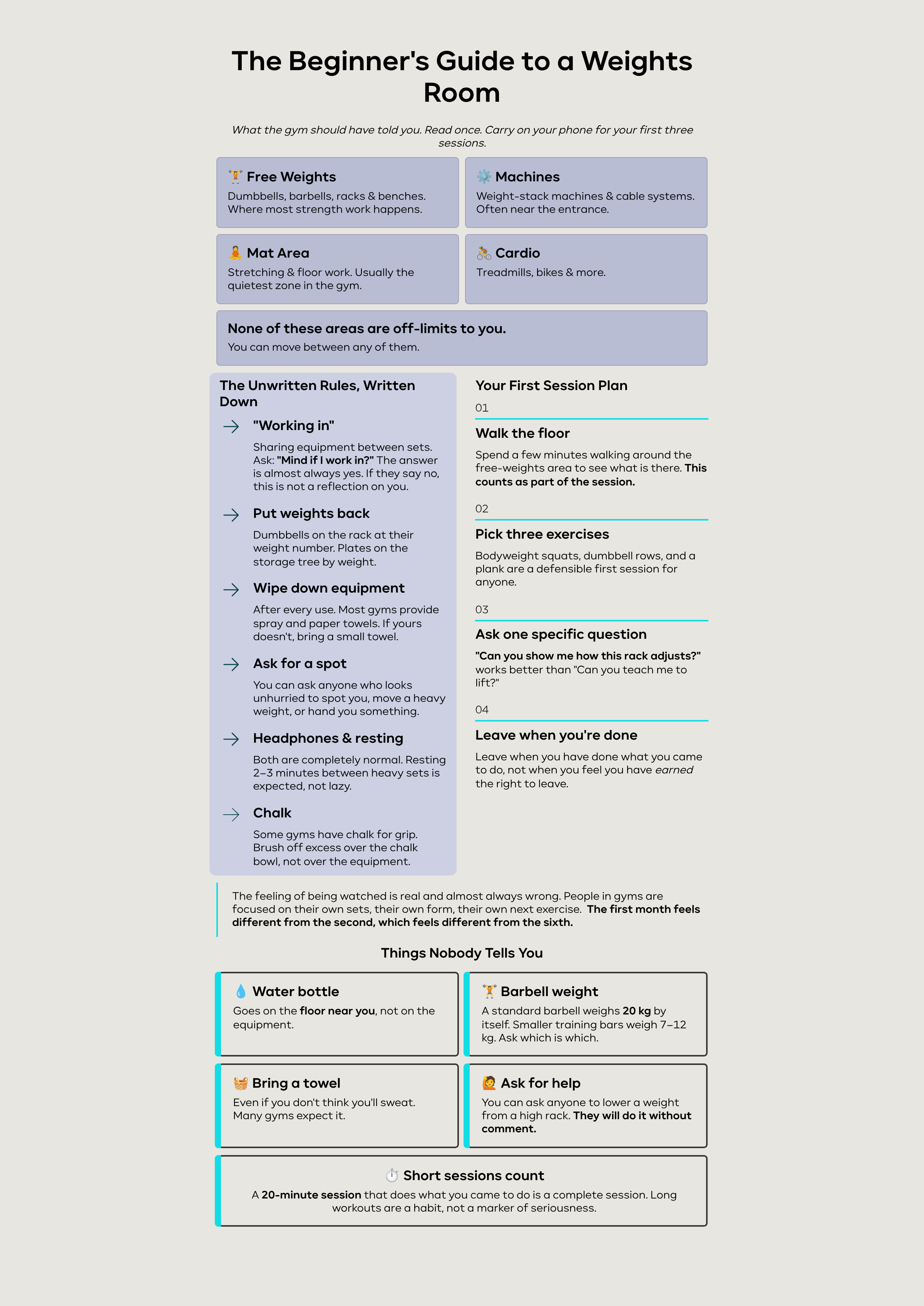
Companion resource / PNG

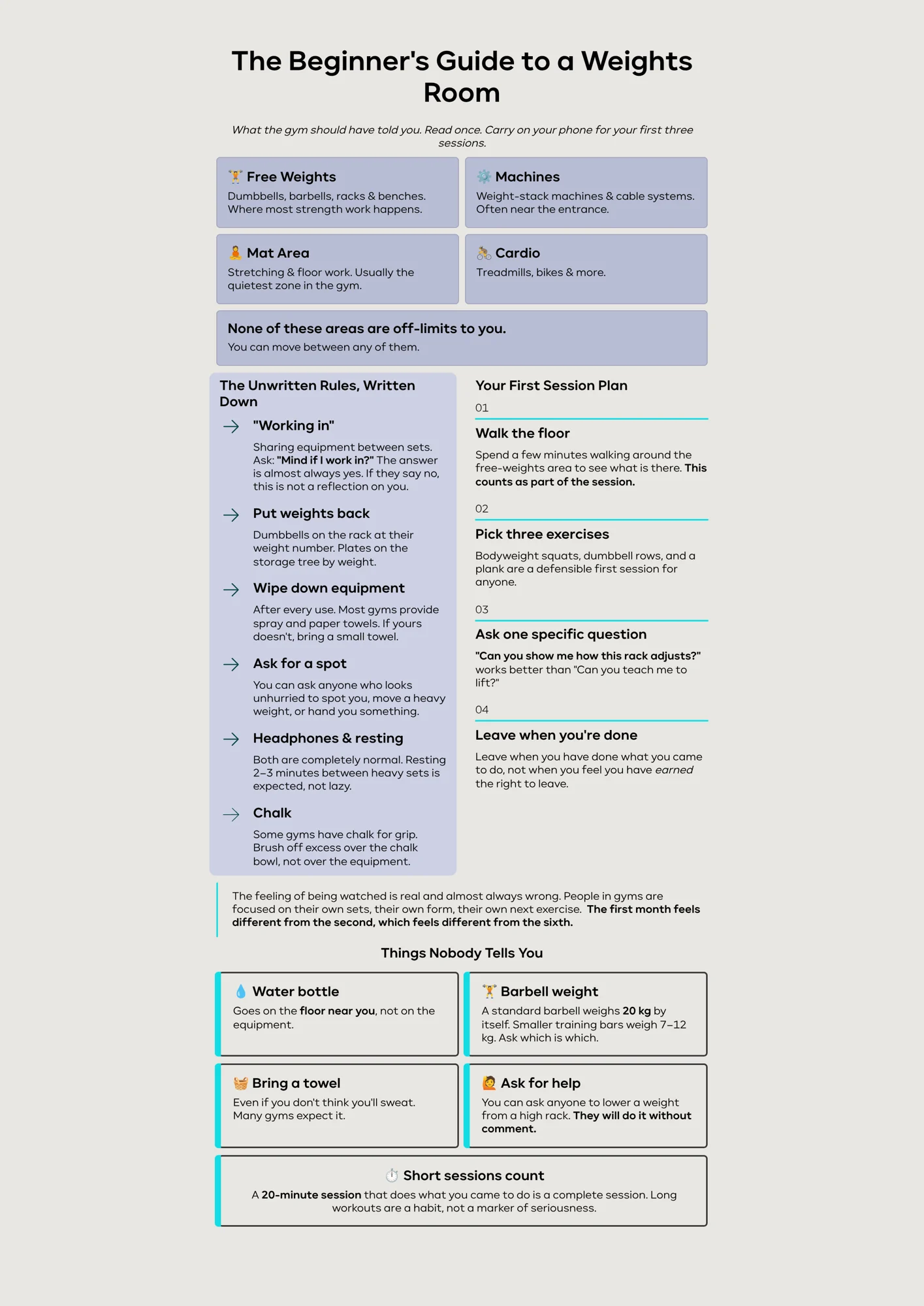
The Beginner’s Guide to a Weights Room

The Beginner’s Guide to a Weights Room — preview of the supplied resource
Download originalPNG · 664 KB
Read the full resource

The Beginner's Guide to a Weights Room

What the gym should have told you. Read once. Carry on your phone for your first three sessions.

Free Weights

Dumbbells, barbells, racks & benches. Where most strength work happens.

Machines

Weight-stack machines & cable systems. Often near the entrance.

Mat Area

Stretching & floor work. Usually the quietest zone in the gym.

Cardio

Treadmills, bikes & more.

None of these areas are off-limits to you.

You can move between any of them.

The Unwritten Rules, Written Down

"Working in"

Sharing equipment between sets. Ask: "Mind if I work in?" The answer is almost always yes. If they say no, this is not a reflection on you.

Put weights back

Dumbbells on the rack at their weight number. Plates on the storage tree by weight.

Wipe down equipment

After every use. Most gyms provide spray and paper towels. If yours doesn't, bring a small towel.

Ask for a spot

You can ask anyone who looks unhurried to spot you, move a heavy weight, or hand you something.

Headphones & resting

Both are completely normal. Resting 2–3 minutes between heavy sets is expected, not lazy.

Chalk

Some gyms have chalk for grip. Brush off excess over the chalk bowl, not over the equipment.

Your First Session Plan

01 / Walk the floor

Spend a few minutes walking around the free-weights area to see what is there. This counts as part of the session.

02 / Pick three exercises

Bodyweight squats, dumbbell rows, and a plank are a defensible first session for anyone.

03 / Ask one specific question

"Can you show me how this rack adjusts?" works better than "Can you teach me to lift?"

04 / Leave when you're done

Leave when you've done what you came to do, not when you feel you have earned the right to leave.

The feeling of being watched is real and almost always wrong. People in gyms are focused on their own sets, their own form, their own next exercise. The first month feels different from the second, which feels different from the sixth.

Things Nobody Tells You

Water bottle

Goes on the floor near you, not on the equipment.

Barbell weight

A standard barbell weighs 20 kg by itself. Smaller training bars weigh 7–12 kg. Ask which is which.

Bring a towel

Even if you don't think you'll sweat. Many gyms expect it.

Ask for help

You can ask anyone to lower a weight from a high rack. They will do it without comment.

Short sessions count

A 20-minute session that does what you came to do is a complete session. Long workouts are a habit, not a marker of seriousness.