Companion resource / PDF
Consent by Design
Read the full resource
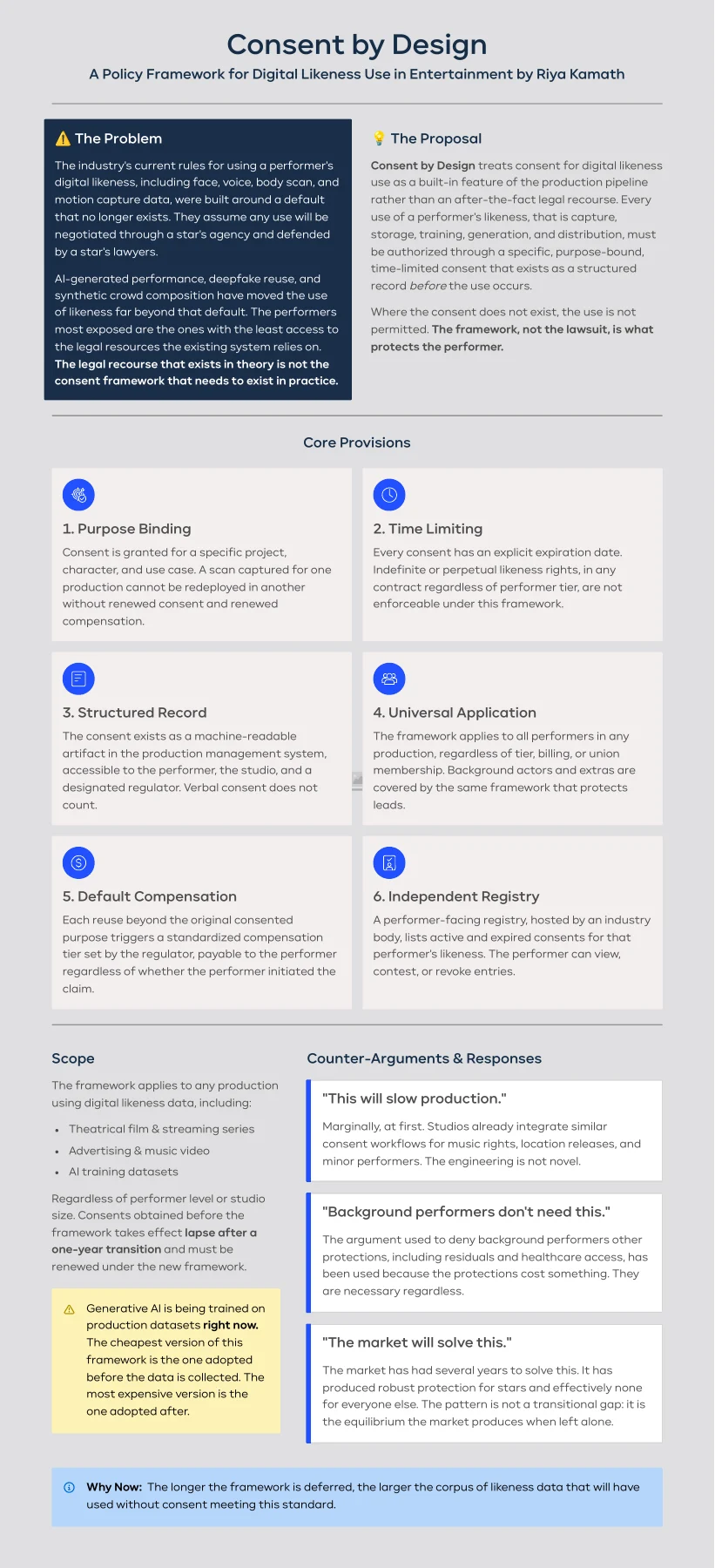
Consent by Design
A Policy Framework for Digital Likeness Use in Entertainment by Riya Kamath
⚠ The Problem
The industry's current rules for using a performer's digital likeness, including face, voice, body scan, and motion capture data, were built around a default that no longer exists. They assume any use will be negotiated through a star's agency and defended by a star's lawyers.
AI-generated performance, deepfake reuse, and synthetic crowd composition have moved the use of likeness far beyond that default. The performers most exposed are the ones with the least access to the legal resources the existing system relies on.
The legal recourse that exists in theory is not the consent framework that needs to exist in practice.
💡 The Proposal
Consent by Design treats consent for digital likeness use as a built-in feature of the production pipeline rather than an after-the-fact legal recourse. Every use of a performer's likeness, that is capture, storage, training, generation, and distribution, must be authorized through a specific, purpose-bound, time-limited consent that exists as a structured record before the use occurs.
Where the consent does not exist, the use is not permitted. The framework, not the lawsuit, is what protects the performer.
Core Provisions
1. Purpose Binding
Consent is granted for a specific project, character, and use case. A scan captured for one production cannot be redeployed in another without renewed consent and renewed compensation.
2. Time Limiting
Every consent has an explicit expiration date.
Indefinite or perpetual likeness rights, in any contract regardless of performer tier, are not enforceable under this framework.
3. Structured Record
The consent exists as a machine-readable artifact in the production management system, accessible to the performer, the studio, and a designated regulator. Verbal consent does not count.
4. Universal Application
The framework applies to all performers in any production, regardless of tier, billing, or union membership. Background actors and extras are covered by the same framework that protects leads.
5. Default Compensation
Each reuse beyond the original consented purpose triggers a standardized compensation tier set by the regulator, payable to the performer regardless of whether the performer initiated the claim.
6. Independent Registry
A performer-facing registry, hosted by an industry body, lists active and expired consents for that performer's likeness. The performer can view, contest, or revoke entries.
Scope
The framework applies to any production using digital likeness data, including:
Theatrical film & streaming series Advertising & music video AI training datasets Regardless of performer level or studio size. Consents obtained before the framework takes effect lapse after a one-year transition and must be renewed under the new framework.
Generative AI is being trained on production datasets right now.
The cheapest version of this framework is the one adopted before the data is collected. The most expensive version is the one adopted after.
Counter-Arguments & Responses
"This will slow production." Marginally, at first. Studios already integrate similar consent workflows for music rights, location releases, and minor performers. The engineering is not novel.
"Background performers don't need this." The argument used to deny background performers other protections, including residuals and healthcare access, has been used because the protections cost something. They are necessary regardless.
"The market will solve this." The market has had several years to solve this. It has produced robust protection for stars and effectively none for everyone else. The pattern is not a transitional gap: it is the equilibrium the market produces when left alone.
Why Now: The longer the framework is deferred, the larger the corpus of likeness data that will have used without consent meeting this standard.