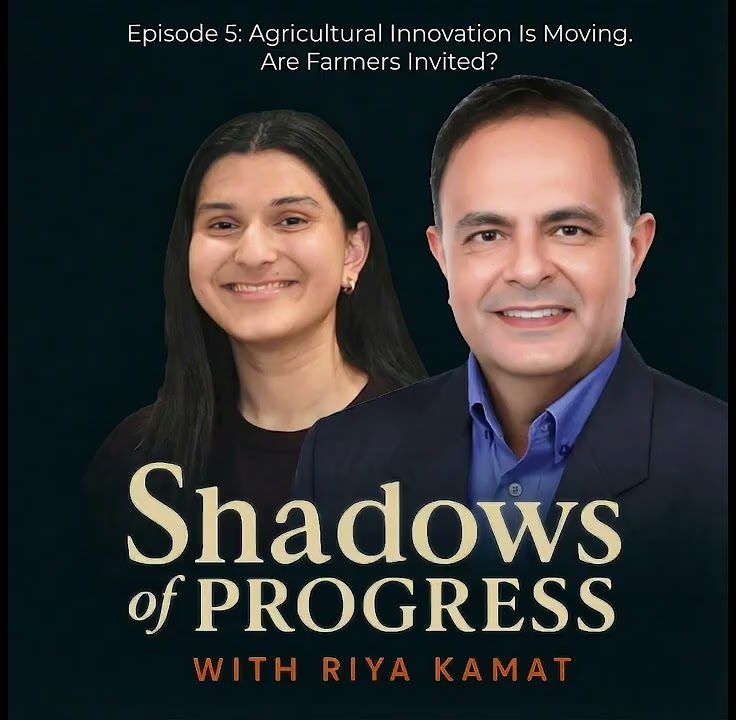
Companion resource / PDF
The Farmer-First Framework
Read the full resource
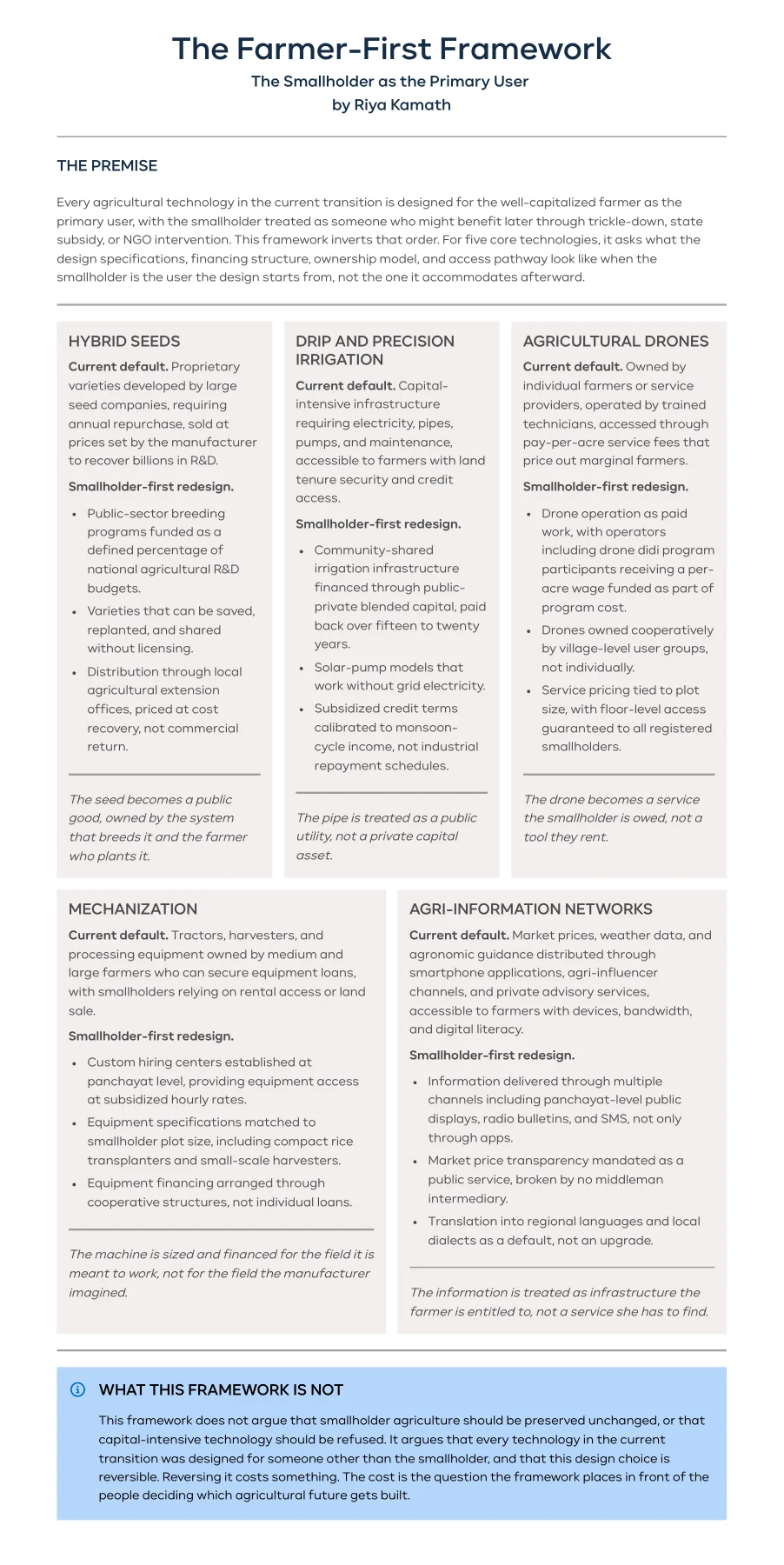
The Farmer-First Framework
The Smallholder as the Primary User
by Riya Kamath
THE PREMISE
Every agricultural technology in the current transition is designed for the well-capitalized farmer as the primary user, with the smallholder treated as someone who might benefit later through trickle-down, state subsidy, or NGO intervention. This framework inverts that order. For five core technologies, it asks what the design specifications, financing structure, ownership model, and access pathway look like when the smallholder is the user the design starts from, not the one it accommodates afterward.
HYBRID SEEDS
Current default. Proprietary varieties developed by large seed companies, requiring annual repurchase, sold at prices set by the manufacturer to recover billions in R&D.
Smallholder-first redesign.
Public-sector breeding programs funded as a defined percentage of national agricultural R&D budgets.
Varieties that can be saved, replanted, and shared without licensing.
Distribution through local agricultural extension offices, priced at cost recovery, not commercial return.
The seed becomes a public good, owned by the system that breeds it and the farmer who plants it.
DRIP AND PRECISION
IRRIGATION
Current default. Capital- intensive infrastructure requiring electricity, pipes, pumps, and maintenance, accessible to farmers with land tenure security and credit access.
Smallholder-first redesign.
Community-shared irrigation infrastructure financed through public- private blended capital, paid back over fifteen to twenty years.
Solar-pump models that work without grid electricity.
Subsidized credit terms calibrated to monsoon- cycle income, not industrial repayment schedules.
The pipe is treated as a public utility, not a private capital asset.
AGRICULTURAL DRONES
Current default. Owned by individual farmers or service providers, operated by trained technicians, accessed through pay-per-acre service fees that price out marginal farmers.
Smallholder-first redesign.
Drone operation as paid work, with operators including drone didi program participants receiving a per- acre wage funded as part of program cost.
Drones owned cooperatively by village-level user groups, not individually.
Service pricing tied to plot size, with floor-level access guaranteed to all registered smallholders.
The drone becomes a service the smallholder is owed, not a tool they rent.
MECHANIZATION
Current default. Tractors, harvesters, and processing equipment owned by medium and large farmers who can secure equipment loans, with smallholders relying on rental access or land sale.
Smallholder-first redesign.
Custom hiring centers established at panchayat level, providing equipment access at subsidized hourly rates.
Equipment specifications matched to smallholder plot size, including compact rice transplanters and small-scale harvesters.
Equipment financing arranged through cooperative structures, not individual loans.
The machine is sized and financed for the field it is meant to work, not for the field the manufacturer imagined.
AGRI-INFORMATION NETWORKS
Current default. Market prices, weather data, and agronomic guidance distributed through smartphone applications, agri-influencer channels, and private advisory services, accessible to farmers with devices, bandwidth, and digital literacy.
Smallholder-first redesign.
Information delivered through multiple channels including panchayat-level public displays, radio bulletins, and SMS, not only through apps.
Market price transparency mandated as a public service, broken by no middleman intermediary.
Translation into regional languages and local dialects as a default, not an upgrade.
The information is treated as infrastructure the farmer is entitled to, not a service she has to find.
WHAT THIS FRAMEWORK IS NOT
This framework does not argue that smallholder agriculture should be preserved unchanged, or that capital-intensive technology should be refused. It argues that every technology in the current transition was designed for someone other than the smallholder, and that this design choice is reversible. Reversing it costs something. The cost is the question the framework places in front of the people deciding which agricultural future gets built.