Skip to content

Media & Algorithms / A design audit by Riya Kamat

The Algorithm Decides Who Is Heard

A creator can have a voice and still be invisible to the system that decides who gets heard.

With Anish MehtaFounder, Animeta
Anish Mehta — Shadows of Progress, episode 1

The conversation, at a glance

A system. A blind spot. A different starting point.

01

The system

Platform recommendation systems turn engagement into visibility and income.

02

Who it overlooks

Regional-language creators and creators without the production resources the platforms reward.

03

Riya’s proposed direction

Reserve space for regional voices, create language-specific pools, and make ranking decisions understandable.

Having a voice isn't the same as building a livelihood, because one algorithm tweak can change everything.

Anish Mehta, in conversation

The design audit / By Riya Kamat

Looking beneath the surface.

7 minute read · Complete source text

Download auditDOCX · 24 KB
Jump to an audit section

The Algorithm Decides Who Is Heard

Shadows of Progress: Episode 1

Guest: Anish Mehta, Founder of Animeta

01

The System

During my internship at Animeta, I watched the same pattern repeat across the creators the team was onboarding. Most were from tier-two and tier-three cities, most posted in regional languages, and almost none were being recommended outside their language community by YouTube’s or Instagram’s discovery systems. The team did its part: found the creators, brought brands in, set up the deals. The platforms did something else.

The system that decided who would scale is not a single algorithm but a stack: YouTube’s recommendation engine and Instagram’s discovery surface, both ranking content through engagement signals, including watch time, completion rate, return visits, that are easier to monetize than to measure for cultural value, and both operating in a country neither was originally designed for. Anish Mehta, who has built a business inside that system, names the consequence directly: the bias against regional, non-English creators is, in his words, “beyond repairable.” That phrase is the one I keep returning to. It does not say the gap is unfortunate, or that it is being worked on. It says the structure has set, and that working creator by creator, post by post, is not the level at which the problem now lives.

02

The Intended User

The default creator imagined by these platforms is urban, English-speaking, on a recent smartphone, posting on a consistent cadence, and producing content with the aesthetic markers of Western digital culture: clean audio, well-lit framing, on-trend formats. The default viewer assumed alongside that creator is similarly placed: high-bandwidth, advertising-receptive, statistically more valuable to brands.

Neither default was chosen maliciously. Both are the residue of where the platforms were built, who built them, and which markets they monetized first. The result is a system that recognizes a Mumbai creator working in English faster than a Bhojpuri creator working in a tier-three town, not because anyone decided it should, but because the first matches a pattern the system was trained and rewarded to find. The Bhojpuri creator is not blocked. They are simply illegible to a system whose categories were drawn before they arrived.

03

Hidden Exclusions

Two groups bear the cost, and the cost is hidden differently for each. The first is the regional-language creator. Anish describes how Animeta’s Brandstar platform was built to actively surface creators to brands because organic platform discovery does not reach many of them on its own. A Tamil cooking creator and an English lifestyle creator can have similar production effort and similar engagement inside their own audiences, and still enter the recommendation pool with the second pre-weighted to win. The exclusion is not a gate at the entrance; it is a slow tilt in the floor. What makes it durable is the feedback loop: a creator who gets less initial reach generates less engagement data, which the system reads as lower quality, which produces less reach next time. A small disadvantage at the start compounds within months. The creator never sees the loop. They only see that their reach plateaus, and they cannot work out why.

The second is the creator displaced by a product decision made above their heads. When YouTube launched Shorts in India after the TikTok ban, short-form creators started receiving millions of views, while long-form creators who who had built careers on the previous format, found themselves with no algorithm advantage on new uploads. The platform did not announce a values shift. It made a product decision, and the decision rearranged whose work would surface. A creator cannot improve their way out of a format change. They can only adapt or accept a lower ceiling.

The clearest evidence the system is not neutral comes from Anish’s own comparison of TikTok in China: surfacing educational content to young users, with the export version surfacing what he calls “dumb entertainment” to the same age cohort abroad. Same company, same technology, deliberately tuned.

04

Embedded Values

The design choice to rank content primarily through engagement signals reveals what this system actually optimizes for: the legibility of content to advertisers. Everything else follows.

It values scale over locality, because scale is easier to sell against. A million viewers across a country is a better pitch to a brand than ten thousand viewers in one linguistic community, even if the smaller community converts at a higher rate. It also values format consistency over format diversity, because consistent formats produce predictable inventory: short vertical video sold to advertisers buying short vertical video. Finally, it values English over regional languages, not as a stated preference but as an emergent consequence of which audiences advertisers paid to reach first. None of these are stated values. They are the values implied by what the system measures and what it ignores.

What gets sacrificed is harder to count, which is part of why it is sacrificed: the small devoted audience inside a language community, the work that rewards a second viewing rather than a faster scroll, the dialect that has fewer than a million speakers but carries the jokes, the prayers, and the everyday business of the place where it is spoken. The metric does not have a column for them. A system that cannot count something will eventually act as if that thing does not exist.

05

Ethical Redesign

Three changes would shift the shape of this system without rebuilding it. None are technically difficult. All are politically inconvenient for the platforms, which is the more honest reason they have not happened.

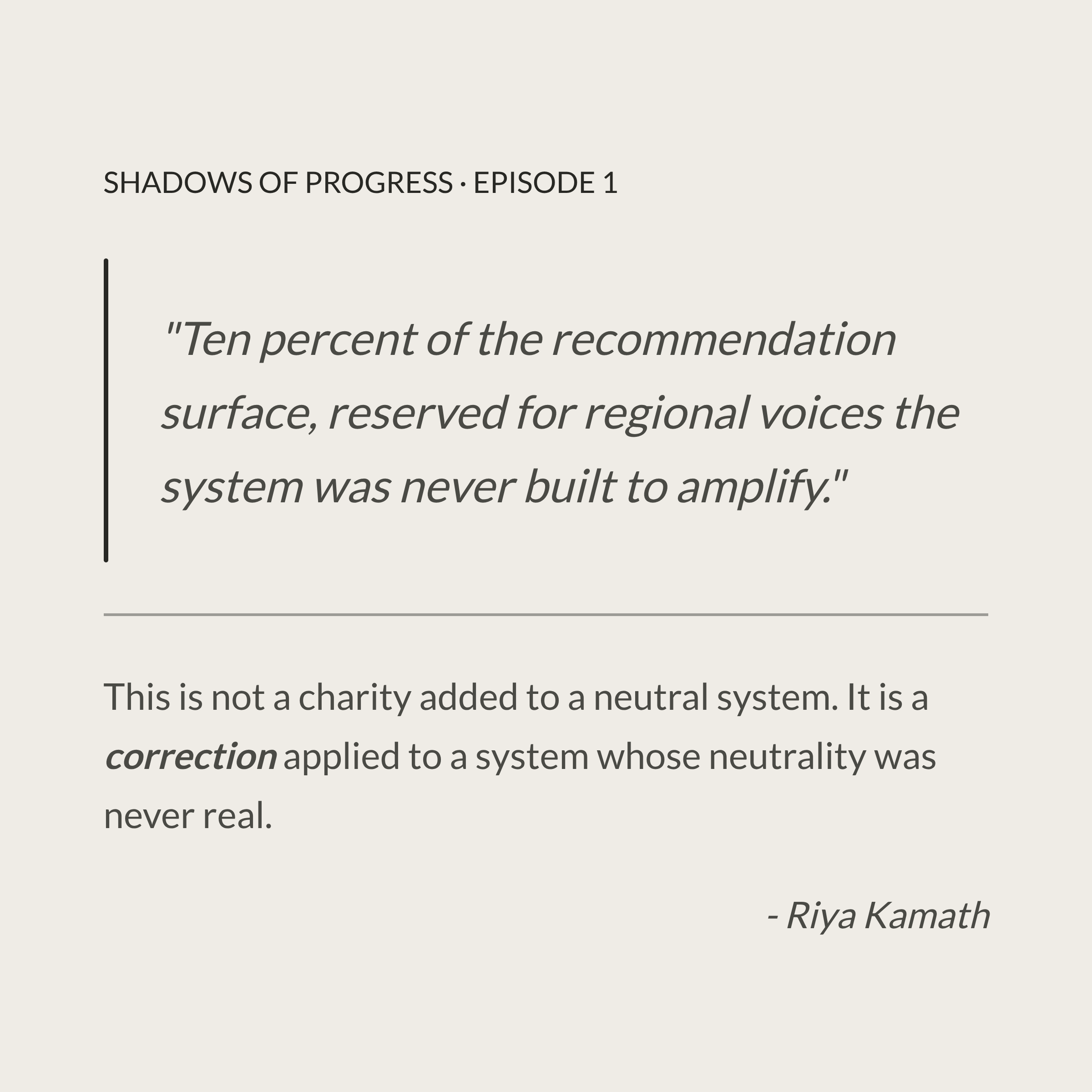
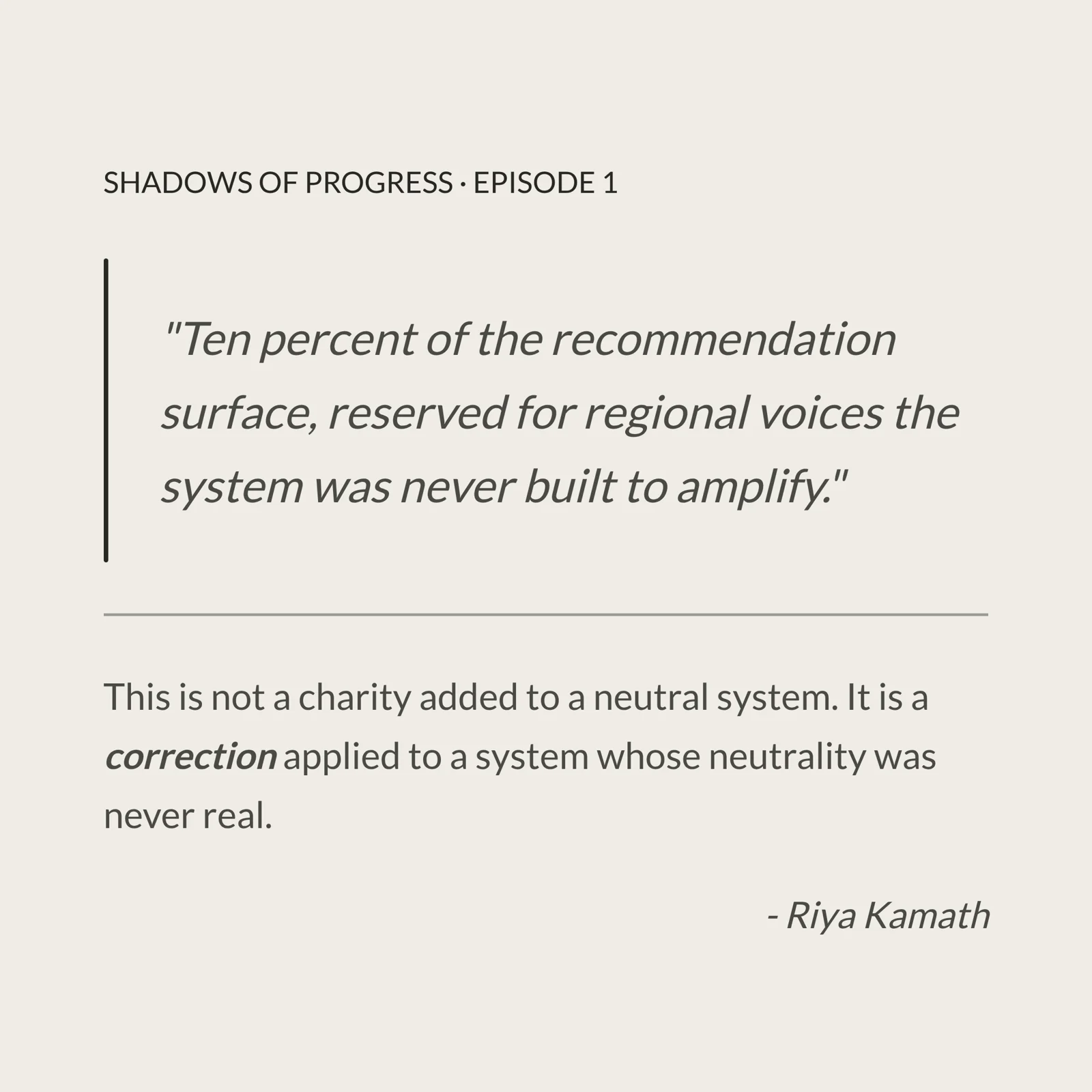
The first is a guaranteed share of the recommendation surface for emerging regional voices. Ten percent is a defensible starting point, going to creators below a follower threshold and publishing in a non-dominant regional language. The mechanism is straightforward: a slot reservation system, similar to how some broadcasters reserve airtime for local content. The objection will be that this is paternalistic, that the algorithm should remain “neutral,” that quotas distort what users want. That argument only stands if one accepts that the current state is neutral. It is not. A system whose defaults already favor English-language, urban, well-resourced creators is making a choice every time it loads a feed. The quota is not the introduction of a distortion. It is the correction of one.

Also, separate recommendation pools by language community, so a Bhojpuri creator competes against other Bhojpuri creators rather than a Mumbai studio operation in English. One might argue that this divides the platform and reduces discovery. However, the current system already divides creators; it just does so in ways that favor whoever was there first. Separating pools makes the division visible and at least fair within each segment.

The third change, and the one that matters most, is the right to know what the algorithm is doing to you. Creators should see, in plain language, which signals are suppressing or amplifying their reach, and they should be able to dispute the read. Platforms claim that revealing ranking signals enables manipulation. That is partially true and mostly a deflection. The current arrangement treats creators as users of a product. They are not users. They are the labor force on which the product depends, and a labor force that cannot see the terms of its own work is not in a just arrangement.
06

Reflection

I went in thinking algorithmic bias was a data problem; that better training sets would close the gap. Reading Sara Pritchard's Confluence alongside this conversation changed that.

Pritchard’s book is about how the Rhône was remade after the Second World War through interrelated technological and political choices: dams, channels, infrastructure for nuclear cooling. None of those choices were announced as decisions about who would live near the river, who would farm what land, what French rural life would look like a generation later. They were announced as engineering. The political reshaping happened underneath, invisible, because it was embedded in something presented as technical.

The recommendation algorithm does the same kind of work in a different domain. It is announced as engineering. The political work it does that involves deciding which languages get amplified, and which creators can make a livelihood happens underneath. What I want to sit with next is what Anish did not quite say: authenticity, the advice founders tend to give creators, is a strategy that only works inside a system that can see you. For many of the creators Animeta onboarded, the system could not.

The system, made visible

Follow the connections.

Select an element to see how it connects to the rest of the system, and who falls outside its assumptions.

Visibility compounds. So does exclusion.

Follow the signals into the recommendation engine, then trace the loop that turns visibility into more visibility.

01 / Inputs

02 / The system

Feedback loop

03 / What gets rewarded

Excluded zone / shown less before ranking

Explore the system

Where would you begin?

Select any element to highlight its connections and jump to the part of the audit it comes from.

Interpretive map by Riya Kamat. Connections describe the source analysis; they are not a quantitative model.
Download mapPDF · 89 KB
Read the complete map as text

E P I S O D E 1

The Algorithm Decides Who Is Heard Advertisers Buy attention at scale Platform revenue Watch time = ad inventory Outputs serve the buyers I n p u t s O u t p u t s Watch time Duration of attention Engagement Likes, comments, shares Upload cadence Frequency of posting YouTube Recommendation Algorithm Creator visibility Surfaced to viewers Brand deals Monetization access Feedback loop More visibility produces more engagement data, which the system reads as quality, producing more visibility. Initial advantages compound. Initial disadvantages do too.

Excluded zone These creators enter the same recommendation pool. They are progressively shown less before ranking.

Regional creators Tier 2 and tier 3 cities Non-English creators Regional languages Low-production Without studio gear Stage 1 Stage 2 Stage 3 Algorithm learns from English-language content that already performs well Lower initial reach → less engagement data System reads as lower quality → further suppression next cycle The creator never sees the loop. They only see that their reach plateaus and cannot work out why. A small disadvantage at the start compounds into a structural one within months.

From inquiry to possibility

Take the thinking further.

Workshops, proposals, and practical resources developed alongside this conversation. Read them here or download the original files.

Companion resource / PNG

Regional voices: a redesign proposal

Regional voices: a redesign proposal — preview of the supplied resource
Download originalPNG · 210 KB
Read the full resource

SHADOWS OF PROGRESS · EPISODE 1

"Ten percent of the recommendation surface, reserved for regional voices the system was never built to amplify."

This is not a charity added to a neutral system. It is a correction applied to a system whose neutrality was never real.

- Riya Kamath