Skip to content

Work & Education / A design audit by Riya Kamat

When India's Corporate Engine Accelerates Who Keeps Up?

Adaptability looks like an individual quality. Its foundations are distributed unevenly.

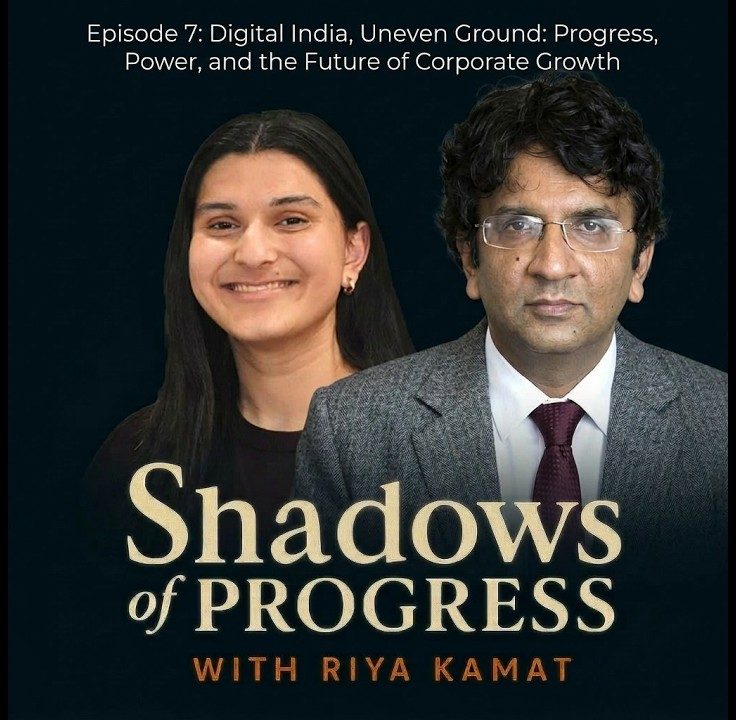
With Uday PimprikarSenior Partner, EY India
Uday Pimprikar — Shadows of Progress, episode 7

The conversation, at a glance

A system. A blind spot. A different starting point.

01

The system

Corporate AI adoption, automation, and formalization reshape work and access to capital.

02

Who it overlooks

Entry-level workers, workers without reskilling support, and businesses outside the formal economy.

03

Riya’s proposed direction

Build income bridges, learning support, and access pathways into the transformation itself.

Elephants always find it difficult to turn. The smaller organizations will be able to scale themselves far easier.

Uday Pimprikar, in conversation

The design audit / By Riya Kamat

Looking beneath the surface.

6 minute read · Complete source text

Download auditDOCX · 26 KB
Jump to an audit section

When India's Corporate Engine Accelerates Who Keeps Up?

Shadows of Progress: Episode 7

Guest: Uday Pimprikar, senior partner at EY India

01

The System

Uday Pimprikar’s central claim about the present moment is that adaptability has replaced capital as the determining factor. The compute that used to be locked behind investment is now in everyone’s hand, he argues. The differentiation, going forward, will not be driven by who has capital, but by who can adapt to use the compute quickly. The question therefore is what adaptability is and what does it depend upon. The system examined is corporate India’s digital transformation as related to finance, tax, consulting, and advisory work. Uday is a senior partner at EY India, with years of experience advising clients through regulatory and technological change. He sees the transformation from inside a global professional services firm whose own work is being reshaped by the same forces.

02

The Intended User

The default beneficiary of the transformation Uday describes is the worker who is positioned to be adaptable. They have stable enough income to take time off paid work to learn. They have professional networks that signal where new opportunities are emerging. They have prior education that scaffolds rapid acquisition of new skills. They have digital fluency that let them engage with new tools without first learning the basics of the medium. They also have a workplace whose managers offer mentorship and psychological safety, which is the environment in which EQ, the second differentiator Uday names, gets developed in the first place.

None of these conditions is adaptability itself. Each is what adaptability rests on. The default worker has them. Many workers do not. Treating adaptability as a personal quality rather than as a product of accumulated advantage is what allows the rest of Uday’s argument to remain unchallenged.

03

Hidden Exclusions

Three exclusions underpin Uday’s optimism, all produced by the same mechanism: the conditions of adaptability are not evenly distributed, and the transformation moves at a speed that punishes those without those conditions.

The first is the worker whose adaptability is limited by structural disadvantage. They do not have the income buffer to pause paid work for reskilling, the professional networks that surface new opportunities, the educational base that makes new tools quickly legible, or the workplace that develops EQ through mentorship. Uday’s framing handles their case with a single sentence: people who do not adapt will probably wilt away, and that is fine. The framing treats their displacement as natural selection. It is not. It is the outcome of a transformation that asked for a quality they were never given the conditions to develop.

The second is the next generation of professionals whose entry-level training has been automated. Uday acknowledges this explicitly. The work that used to teach junior accountants and consultants by doing has been absorbed into AI tools. The deep understanding that came from doing the work manually is what is at risk. Firms like his are trying to enhance training. What is missing is a systematic training path available across organizations, regardless of size. Without it, deep expertise will become a privilege of firms that choose to invest in it.

The third is the informal economy that GST-linked trade finance does not reach. Uday names GST data as the source of a new credit pipeline for small businesses. The pipeline is real and is a real inclusion. It is also conditional on formalization into the GST system, which the majority of India’s small enterprises are not part of. The capital democratization Uday describes runs along a track most of the economy is not on.

04

Embedded Values

What corporate digital transformation optimizes for is visible in what Uday is asked to deliver to his clients: efficiency, speed of execution, scale of operation, and shareholder return. These are the metrics his industry can measure cleanly and reward consistently. The transformation that produces them is the one EY and its peers are paid to advise on.

What the transformation does not optimize for is workforce continuity, equitable skill access, or the maintenance of learning pathways. None of these has a clean metric. None of them is on any client’s quarterly dashboard. The displaced worker, the junior whose training disappeared, the informal-economy small business outside the GST pipeline are absent from the optimization function because they do not show up in what the firm is asked to count.

The most distinct value embedded in the conversation is not adaptability itself, but tolerance for losses. When pressed on people who cannot adapt, he treats worker displacement as a natural cycle. The framing dissolves accountability the way the word “natural” tends to. Nothing is anyone’s responsibility because nothing was anyone’s decision. The transformation simply happens, and some individuals do not survive it.

05

Ethical Redesign

The redesigns that follow do not slow the transformation Uday describes. Instead, they make participation in it possible for people the current arrangement leaves out.

First, structured learning pathways are needed to replace what automation removes at entry level. Firms automating junior work should be required to co-design explicit replacement pathways: structured rotations, mentored simulation exercises, case study libraries that reconstruct the deep understanding the manual work used to build. Although this might raise costs, the unmeasured cost of doing nothing is the next generation of professionals who never developed the depth their seniors did. The replacement is not optional; it is the price of choosing automation over apprenticeship.

Reskilling transition stipends should also be provided. Firms above a threshold size that automate roles should contribute to a transition fund that provides a partial income bridge for displaced workers during the reskilling period. The reskilling Uday describes as the new requirement is only realistic for workers who can afford to pause paid work to do it. A skeptic will say this is a redistribution scheme dressed as labor policy. It is more accurate to call it the real cost of automation. The firm captures the productivity gain; the worker pays the transition cost; the stipend makes that cost visible.

Finally, the GST-linked capital pipeline should be extended to the informal economy through cooperative and self-help-group structures. The pipeline Uday celebrates currently requires full GST formalization. A redesign builds the ramp: cooperative credit records that aggregate informal-economy transactions into bankable signals, self-help-group guarantees that substitute for the formal compliance the system currently demands. This might introduce risk into the lending model, but the current model has resolved that risk by excluding most of the economy.

06

Reflection

Uday’s most revealing sentence was three words long. People who do not adapt, he said, will probably wilt away, and added, that is fine.

I am not certain he meant the harshness it bears when written down.

In the conversation, it sounded like someone describing a natural process outside his own field of action. The verb he chose is botanical. A plant wilts. Nothing is responsible for the wilting; it is what happens when conditions are wrong. This is the part of the framing one needs to push on. Worker displacement is not a plant in a window. It is the predictable outcome of decisions made by firms that automated, by investors who funded the automation, by educational systems that did not build the bridges, by governments that chose not to intervene.

Each of those is a design choice. Calling the result a wilting flower lets the choices stay invisible.

The system, made visible

Follow the connections.

Select an element to see how it connects to the rest of the system, and who falls outside its assumptions.

Adaptability rests on accumulated advantage.

Look beneath the visible claim to the five structural preconditions a worker needs in order to adapt.

The visible surface

The foundation / five preconditions

Who is positioned to benefit

Who the foundation leaves out

Explore the system

Where would you begin?

Select any element to highlight its connections and jump to the part of the audit it comes from.

Interpretive map by Riya Kamat. Connections describe the source analysis; they are not a quantitative model.
Download mapPDF · 103 KB
Read the complete map as text

Inputs / What firms invest

Whose interests it serves Outputs Large firms, digitally fluent professionals The workers already positioned to be “adaptable.” Capital investment AI tools, infrastructure Data infrastructure GST data, analytics platforms Regulatory frameworks GST formalization, compliance AI and automation Tools replacing manual work CORPORATE AI ADOPTION: What looks like adaptability rests on a foundation that is not distributed evenly THE VISIBLE SURFACE: “Adaptability is the new differentiator” Treated as a personal quality, available to anyone who chooses to take it up.

rests on ↓ THE FOUNDATION: Five structural preconditions adaptability requires Income buffer Stable enough income to pause paid work for reskilling ✓ Default worker ✕ Most workers Professional networks Connections that signal where new opportunities are emerging ✓ Default worker ✕ Most workers Prior education Educational base that scaffolds rapid acquisition of new skills ✓ Default worker ✕ Most workers Digital fluency Comfort with new tools without first learning the medium ✓ Default worker ✕ Most workers Workplace EQ-development environment Mentorship and psychological safety that builds EQ over time ✓ Default worker ✕ Most workers Efficiency Speed of execution Scale of operation Shareholder return Adaptability is not a personal quality. It is a product of accumulated advantage. The system rewards what the foundation already distributed.

Excluded: three populations, three different mechanisms Entry-level workers Where careers used to begin The work that taught junior accountants and consultants by doing has been absorbed into AI tools. The training pathway is gone before any replacement was built. Deep expertise becomes a privilege of firms that choose to invest in it.

Workers without reskilling support Treated as natural casualties of the transformation No income buffer to pause work, no networks to surface alternatives, no educational base to learn quickly. Uday’s frame: they will probably wilt away, and that is fine. The framing dissolves the accountability the condition produces.

Informal economy Outside the GST formalization that opens the new credit pipeline Capital democratization through GST-linked trade finance reaches businesses inside the GST system. Most of India’s small enterprises are not. The democratization Uday describes runs along a track most of the economy is not on.

E P I S O D E 7

When India's Corporate Engine Accelerates Who Keeps Up?

From inquiry to possibility

Take the thinking further.

Workshops, proposals, and practical resources developed alongside this conversation. Read them here or download the original files.

Companion resource / DOCX

The Adaptability Audit

Download originalDOCX · 24 KB
Read the full resource

The Adaptability Audit

A diagnostic tool for organizational AI adoption plans, by Riya Kamath

THE PREMISE

Most AI adoption plans claim the workforce will adapt. The claim treats adaptability as a personal quality. It is not. Adaptability is what a worker can do when they have the conditions to do it. This tool tests whether a firm’s plan creates those conditions for all its workers or only for the ones who already had them. It is organised around the five structural preconditions adaptability rests on. Apply each section to a real firm’s plan. The pattern of answers shows whether the plan enables broad adaptation or amplifies advantage that already existed.

1. INCOME BUFFER

The diagnostic question. Does the plan provide a financial bridge for workers reskilling during work hours displaced by automation?

Sub-questions.

  • Are workers reskilled on paid time, or on personal time after work?
  • If a worker’s role is eliminated, does the firm provide a transition stipend covering the reskilling period?
  • Is the stipend available to all displaced workers, or only those above a salary threshold?

Passing answer. Reskilling is paid time; displaced workers receive an income bridge between roles. Failing answer. Workers reskill on personal time; displaced workers are released with severance and a recommendation to retrain elsewhere.

2. PROFESSIONAL NETWORKS

The diagnostic question. Does the plan create network access for workers who do not already have it?

Sub-questions.

  • Are mentorship matches assigned, or left to informal pairing among employees who already know each other?
  • Are cross-functional rotations open to all employees, or only to those flagged as high-potential?
  • Does the firm sponsor industry exposure (conferences, communities of practice) for non-senior staff?

Passing answer. Mentorship is assigned and tracked, rotations are open across the workforce, junior staff get industry exposure as a commitment.

Failing answer. Networking is implicit, optional, and concentrates among employees who already have networks coming in.

3. PRIOR EDUCATION AND LEARNING SCAFFOLDING

The diagnostic question. Does the plan accommodate workers whose prior education does not prepare them for rapid technical learning?

Sub-questions.

  • Is reskilling designed for the median worker’s starting point, or for the worker already conversant with the underlying concepts?
  • Are foundations courses (statistics, basic coding, data literacy) offered before advanced training, or assumed?
  • Is content available in multiple modalities and at multiple entry difficulty levels?

Passing answer. Reskilling has explicit on-ramps for workers without prior technical education and meets them where they are.

Failing answer. Training assumes a baseline that excludes the workers most likely to be displaced.

4. DIGITAL FLUENCY

The diagnostic question. Does the plan account for variation in baseline digital fluency rather than assuming it?

Sub-questions.

  • Has the firm measured digital fluency across its workforce, or is the assessment implicit in role assignment?
  • Are AI tools introduced with structured onboarding for workers new to similar tools?
  • Does the firm provide one-to-one or small-group support, or only group training sessions?

Passing answer. Digital fluency is measured, gaps are named, onboarding is differentiated.

Failing answer. Tools are deployed organisation-wide with a single training session, and the workers who cannot keep up are categorised as not adapting.

5. WORKPLACE EQ-DEVELOPMENT ENVIRONMENT

The diagnostic question. Does the plan invest in the conditions that develop EQ as deliberately as it invests in technical training?

Sub-questions.

  • Are psychological safety conditions measured at team level and tied to manager performance?
  • Are managers trained in mentorship, feedback, and developmental conversations as a core competency?
  • Is cross-functional exposure structured for all employees, or available only to those who pursue it independently?

Passing answer. EQ development is treated as organisational infrastructure, not as a privilege of having a good manager.

Failing answer. EQ is named as the differentiator in leadership communications and left to chance in everyday practice.

READING THE RESULTS

A firm whose plan passes most diagnostics across the five preconditions has built a transformation that enables broad adaptation. A firm that passes on income buffer and digital fluency but fails on networks, education, and EQ has built a transformation that rewards employees who arrived with those advantages already. A firm that fails on most diagnostics has not built a transformation workers can adapt to. It has built one that selects for workers who do not need to.

WHAT THIS TOOL IS NOT

This tool does not measure whether a firm’s AI adoption is morally good or commercially successful. It measures whether the plan creates the conditions under which most of its workers can adapt, or whether the plan operates on the unspoken assumption that the conditions are already distributed. The first kind of plan produces an adapted workforce. The second kind produces a sorted one.